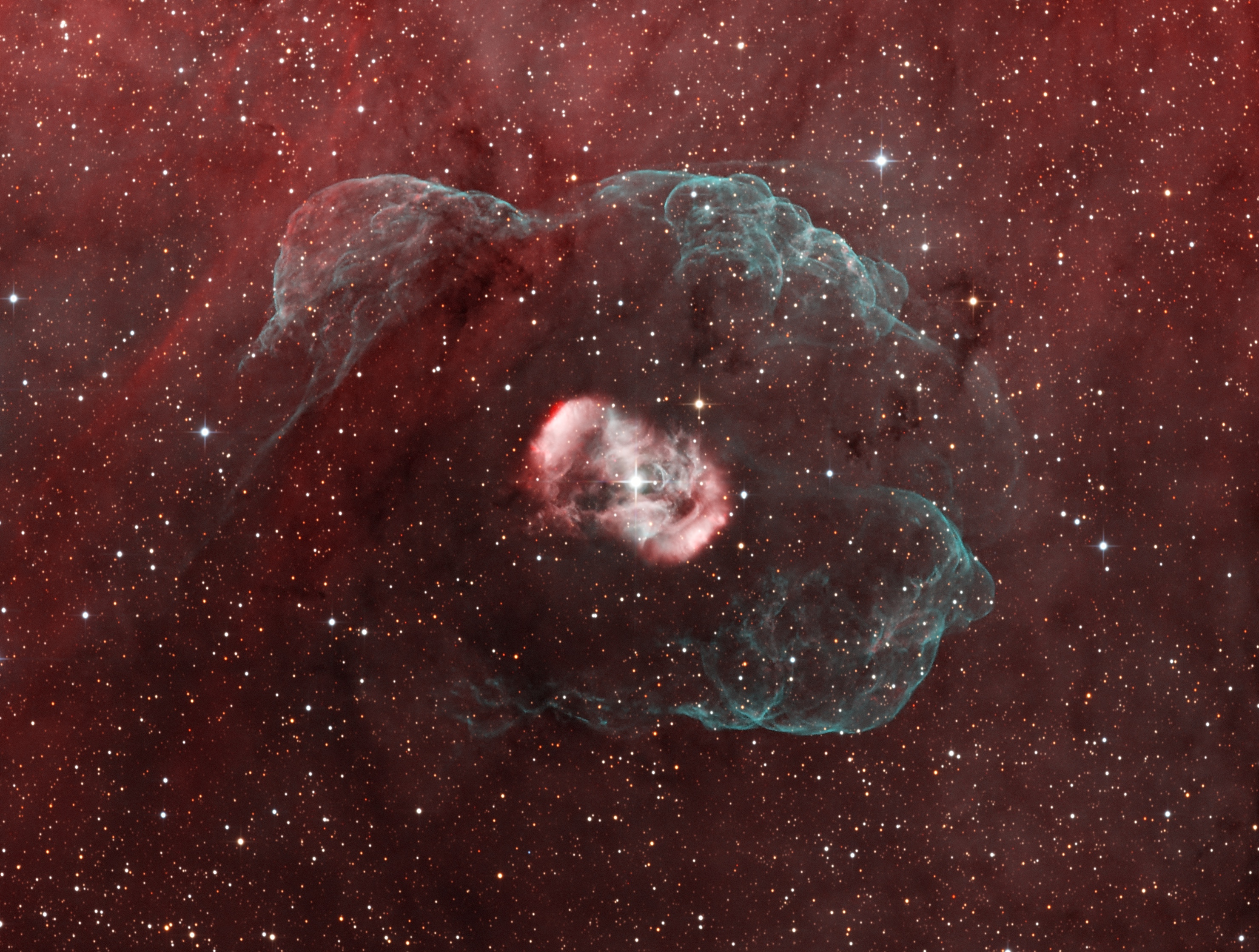
The Dragon's Egg Nebula (NGC 6164) is a rare and fascinating emission nebula surrounding the massive O-type star HD 148937 in the southern constellation Norma. It lies at an estimated distance of 3800 light-years from Earth and spans approximately 3.5 light-years in diameter. Although its morphology resembles planetary nebulae, NGC 6164 is not one of them. Planetary nebulae form at the end of the life of low-mass stars, when the equilibrium between outward pressure generated by the fusion in the star's core and gravity becomes unstable resulting in multiple mass-ejection episodes. But the central star of NGC 6164 is not a dying star, and is far from being low-mass.
The Central Star: HD 148937
HD 148937 is an extremely luminous O6 type star, known for its intense radiation and strong magnetic fields. It's mass is about 30 times larger than our Sun's. It has a surface temperature exceeding 35000 K and a luminosity over 150000 times that of the Sun. Some studies suggest that HD 148937 could be in a transitional phase, evolving toward a Luminous Blue Variable (LBV) or Wolf-Rayet stage.
Its age is about 5 million years, which is halfway through its expected lifespan calculated from its initial mass. In another 5-6 million years the star's life will end in a supernova event.
Structure and formation of the nebula
O type stars produce strong stellar winds and emit high intensity UV radiation. The winds form bubble-like structures in the interstellar material around the star, and the UV radiation ionizes the gas molecules. Spectral analysis of interstellar material around the central star identified an abundance of nitrogen which must have formed within the star. This discovery indicates that although HD 148937 has not reached its end of life, it must have ejected mass into its surroundings.
The bipolar nature of the nebula around the star is also very similar in appearance to planetary nebulae. It thought to be formed by bilateral mass-ejection due the strong magnetic field of the central star. The outer blue shell is rich in oxygen, and is a result of an earlier active episode of HD 148937.
Discovery and Observational History
NGC 6164 was first documented by John Herschel in 1834 during his extensive astronomical surveys of the Southern Hemisphere. His observations contributed significantly to early catalogs of deep-sky objects, and later spectral studies confirmed the nebula’s high-energy nature and unique composition.
Scientific Significance
NGC 6164 provides a valuable astrophysical laboratory for studying massive star evolution, stellar wind interactions, and bipolar nebula formation mechanisms. The presence of a magnetized central star adds another layer of complexity, as magnetic fields may play a role in shaping the observed morphology. Additionally, the nebula’s nitrogen-rich composition offers insights into the internal processes of massive stars before they end their lifecycles in supernova events.
With its bipolar symmetry, chemically enriched gas, and powerful stellar feedback mechanisms, NGC 6164 remains an intriguing subject of study, offering clues about the dynamics of high-mass stellar evolution and the fate of massive O-type stars.


