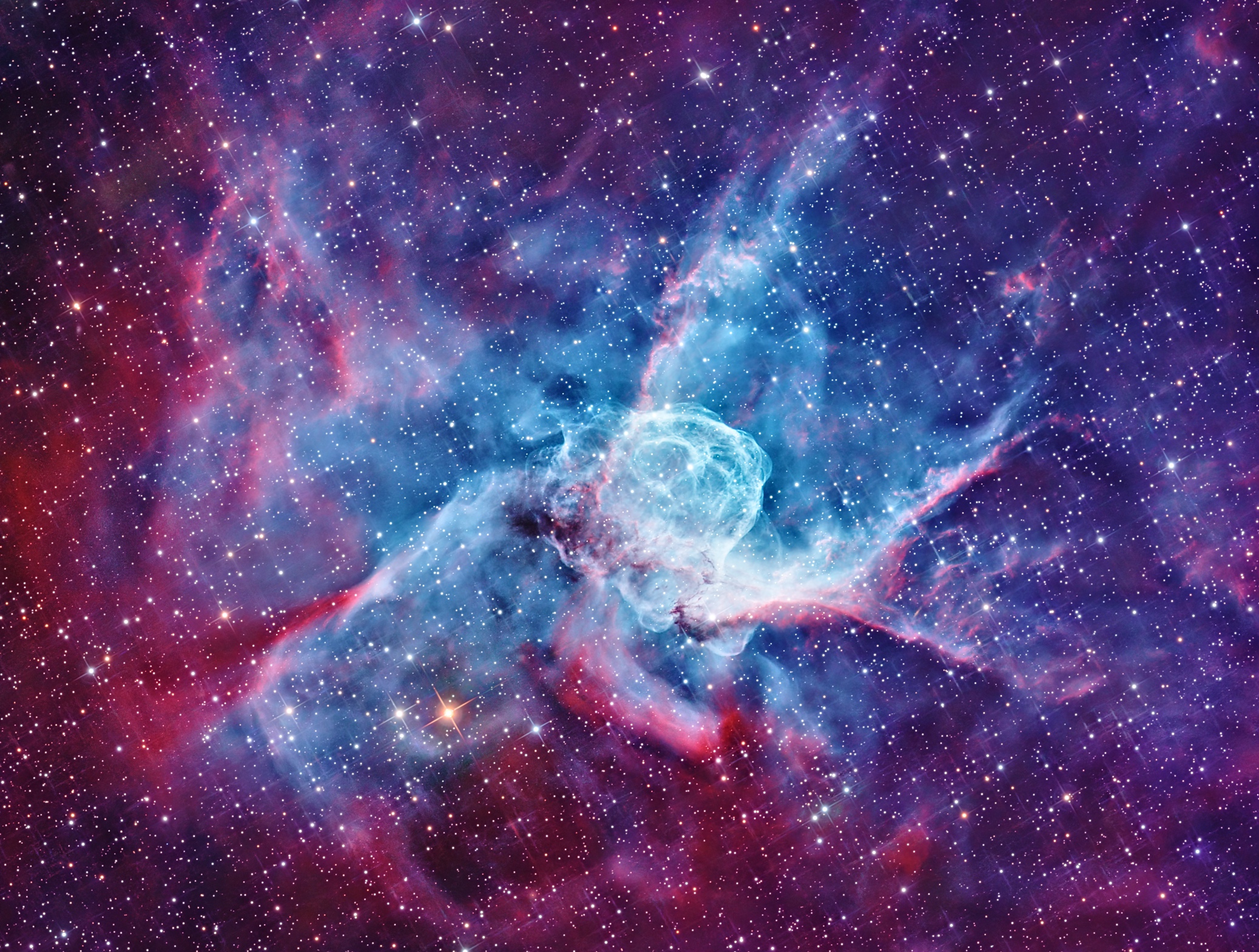
Thor's Helmet (NGC 2359) is an emission nebula located in the constellation Canis Major, approximately 12000 light-years from Earth, spanning about 30 light-years in diameter. Its popular name comes from the unmistakable resemblance of its shape to depictions of the helmet of the Norse god of thunder — a central bubble flanked by curved, wing-like lobes extending to either side. It is also catalogued as Sharpless 2-298 and Gum 4.
The Central Star: WR 7
The engine behind Thor's Helmet is WR 7, also designated HD 56925, a Wolf-Rayet star situated near the center of the nebula. Wolf-Rayet stars are a rare and extreme class of massive, evolved stars in the final stage of their lives, characterised by very high surface temperatures and an exceptionally intense stellar wind that drives mass loss at enormous rates. WR 7 has a surface temperature exceeding 112000 K, a luminosity about 280000 times that of our Sun, and a mass roughly 16 times greater. It is approximately 20 million years old, which, given its high initial mass, places it well into the final chapter of its life.
The progenitors of Wolf-Rayet stars are thought to be either red supergiants or luminous blue variable (LBV) stars. As these massive stars age, they shed their outer layers progressively. Once the Wolf-Rayet phase begins, the fast and powerful stellar wind sweeps up the material ejected during earlier phases, along with interstellar matter from the surroundings, forming the bubble-like structures that are characteristic of Wolf-Rayet nebulae.
The fate of WR 7 is not in question — it will end its life in a supernova, possibly a Type Ib or Ic event, expected within the next few thousand years on a cosmic timescale. If the remaining core is massive enough, a black hole will be the final remnant.
Structure and Formation
The overall shape of NGC 2359 is that of a wind-blown bubble, but the details of its structure are considerably more complex than a simple sphere. The expansion rate varies across different parts of the nebula, ranging from around 10 km/s to at least 30 km/s, giving age estimates for the nebula of between 78500 and 236000 years. The nebula contains several hundred solar masses of ionised material, along with several thousand more solar masses of un-ionised gas.
What makes Thor's Helmet particularly interesting compared to simpler Wolf-Rayet bubbles, such as the Bubble Nebula, is the influence of a nearby large molecular cloud. The interaction between the expanding bubble and this dense cloud is thought to be responsible for the asymmetric, helmet-like morphology and the curved bow-shock structure visible in images. Some of the nebular material shows chemical enrichment consistent with products of stellar nuclear fusion, indicating that at least a portion of the gas originates directly from the star itself, not just the swept-up interstellar medium.
Studies at radio wavelengths have identified multiple layers of shocked molecular gas around the nebula. These layers are thought to record the history of HD 56925's mass-loss episodes — a record written in concentric shells of disturbed gas, each corresponding to a different evolutionary phase of the star.
Discovery and Observational History
NGC 2359 was discovered on 31 January 1785 by William Herschel using his 18.7-inch reflector. In his notes he described it as "a broad extended nebulosity" forming a roughly parallelogram shape — not the most poetic description for what we now recognise as one of the more visually dramatic objects in the sky, but understandable given the limitations of visual observation. His son John Herschel, who studied the object later, was reminded of a bust depicting a head and shoulders — closer to the mark, though still not quite a helmet.
The western, fainter portion of the nebula, now sometimes referred to as IC 468, was not identified as a separate entry until 25 February 1887, when French astronomer Guillaume Bigourdan observed it independently. It was added by John Dreyer to the Index Catalogue in 1895.
The significance of the central star's nature only became apparent in the early twentieth century. Between 1917 and 1919, Francis Pease studied the nebula at the Mount Wilson Observatory in California and connected it to its Wolf-Rayet central star, making NGC 2359 the first Wolf-Rayet nebula to be identified as such. It received its NGC designation from John Louis Emil Dreyer's New General Catalogue of Nebulae and Clusters of Stars, published in 1888.
Scientific Significance
NGC 2359 serves as one of the most studied examples of a Wolf-Rayet wind-driven nebula, offering insight into how massive stars shape their immediate surroundings during the final stages of their evolution. The layered structure of the surrounding molecular gas provides a direct record of the star's mass-loss history, allowing researchers to reconstruct the evolutionary sequence from an earlier LBV or red supergiant phase through to the current Wolf-Rayet stage.
The interaction with the neighbouring molecular cloud adds another dimension to the science, as it demonstrates how the local interstellar environment can fundamentally alter the outcome of stellar wind dynamics. Rather than forming a symmetric bubble, the expanding shell has been deflected and compressed, producing the complex filamentary morphology that makes this object so visually striking and scientifically valuable.
When WR 7 eventually explodes as a supernova, the expanding remnant will sweep through the pre-shaped cavity of Thor's Helmet, interacting with the very material the star itself expelled over millions of years. In that sense the nebula is not just a beautiful structure — it is the stage already being set for a spectacular final act.


